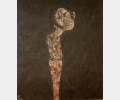
Sabhan Adam 

Works in reserve

  • Introduction
  • Curriculum vitae
  • Chat
  • Statements


Introduction


Since 2002, over the years, the personality of this prolific artist asserts itself and matures. What shows the evolution of his work, completely centred on the expression of his perception of the humanity. In his metaphysical pictorial language, he investigates with intensity this "night of bodies" where from appears the truth: his painting. At only 36, this young self-taught painter has achieved to create a truly personal world far from traditional beauty standards.


Sabhan Adam: a few landmarks
Born on January 19, 1972 in Hassakeh, Syria. Self-taught, he starts painting at the age of 17, but he is also involved in philosophy, poetry, sociology; his works were at first published in the local press. From June to December 1999, he resides at the Cité Internationale des Arts of Paris. Since 2003, he has exhibited with Dominique Polad Hardouin in solo and group shows, in the gallery and in other venues. He also exhibits with Cavin Morris in New York. He has become on of the leading artists of the Middle East.


Curriculum vitae


Born on 19 January 1972 in Hassakeh, Syria
At seventeen he takes up painting on his own; philosophy, poetry, sociology interest him. He publishes his works and his poetry in the press.

June to December 1999 : he boards at the Cité Internationale des Arts in Paris, France.
 

Solo exhibits

1994
Institut Goethe, Damas, Syria
1995
Centre Cervantès, Damas, Syria
Centre culturel français, Damas, Syria
Galerie Agial, Beyrouth, Lebanon
1996 
Centre culturel français, Damas, Syria
1998
Cham-Palace Hotel, Alep, Syria
Galerie Bruno Frey, Dijon, France
1999 
Espace de Lille, Nice, France
Galerie Cité Internationale des Arts, Paris, France
Galerie Transversale, Paris, France
2000
Galerie Orient, Amman, Jordania
2001
Centre culturel français, Damas, Syria
2002 
Galerie Agial, Beyrouth, Lebanon
Galerie Zara, Amman, Jordania
Centre culturel français, Damas, Syria
Atrium du Faubourg, Tripoli, Lebanon
Galerie Commines, Paris, France
National Museum of Jordania
2003
« La comédie humaine » - Galerie idées d’artistes, Paris, France
« One man show », médiathèque François Mitterrand, Les Ulis, France
Centre Culturel Français, Damas, Syria
2004
Espace SD, Beyrouth, Liban
Galerie Zara, Amman, Jordania
Galerie Daniel Duchoze, Rouen, France
Galerie Art Tunis, Tunis, Tunisia
Galerie Lillebonne, Nancy, France
Galerie Off-Ample, Barcelone, Spain
Phyllis King Gallery, New-York, USA
2005
Centre Culturel André Malraux, Kremlin Bicêtre, France
« Entre noir & or » - Galerie idées d’artistes, Paris, France
« Drawings » - Rouer, Bernard, Bretout et Yearlings Corporate Finance, Paris, France
Chocolaterie du Kremlin-Bicêtre, France
Cavin Morris Gallery, New York, USA
2006
Galerie Fallet, Genève, Switzerland
Cavin Morris Gallery, New York
Galerie Mathias Beck, Hambourg, Germany
Home’Art, Perros-Guirec, France
Chapelle Sainte-Anne, Tours
Art Space, Dubaï
Galerie Karim Françis, Le Caire, Egypt
2007
Galerie Oms, Perpignan, France
XVA Gallery, Dubaï
« Dans la nuit du temps » - Collégiale Saint-Pierre-la Cour, musée des Beaux-arts du Mans
Galerie idées d’artistes, Paris
Galerie Meyer-Le Bihan, Paris
Espace culturel André-Malraux, Le Kremlin-Bicêtre, France
Foresight Art Center Lama Hourani, Amman, Jordania
Art House, Damas, Syria
2008    
Centre CCF Damas, Syrie
« Beggar or King? » Galerie Polad-Hardouin, Paris
Art Space, Dubaï

Fairs

2003
Salon d’Angers, Galerie idées d’artistes, France
2004
« Désirs Bruts », Ville des Ulis, France
« Outsider Art Fair », Phyllis Kind Gallery, New York, USA
Festival Art&Déchirure, Rouen, France
Art Paris, Galerie idées d’artistes, Paris, France
2005
Guest of honor, festival « A3 », place Saint Sulpice, Paris, France
Salon de Mai, Paris
2006
Salon de Lyon, France
Salon Comparaisons, Paris
2007
Salon du dessin contemporain, Paris, galerie Polad-Hardouin, France
2008
Salon du dessin d’art contemporain, Paris, galerie Polad-Hardouin, France
 

Publishing

2004
Catalog, Galerie Daniel Duchoze, Rouen, France
Catalog Galerie Off-Ample, Barcelone, Espagne
2005
Editions Fragments (French and English), text by Adonis
2006
Portfolio with original marouflés drawings
2007
Sabhan Adam, The Museum Collection, Ayyam gallery, Damas, Syrie
2008
Monograph (215 pages, 130 illustrations)
 

Public Collections

2007
CNAP, French Ministry of Culture


Chat


The third interview given by the artist to the Lebanese journalist Diala Gemayel.


August 11, 2007. It’s my third meeting with Sabhan Adam. Its purpose is the publishing of his monograph. Once again, he came straight from Hassakeh, after an eight-hour road trip. And once again, he is slightly early. I chose to meet him outside Beirut, in a small restaurant facing the sea. He accepted it, for our meeting place is not the point.

Eleven in the morning. We are done with the regular politeness – both of us prefer minimum of the kind, in fear of the never-ending rituals of our countries. Sabhan Adam is lightning the second of the fifteen or eighteen cigarettes that he will be taking out of the pocket of his shirt during our long two-hour conversation.

The Hassakeh painter is still as rebel as ever and meticulously organized. The meeting’s topic is crystal clear: “I am the only one who knows who I am. The cultural world put a great spoke in my wheels when I intended to publish a book of my drawings. Therefore I want our conversation, here and now, to be my book’s text. No analysis, no critics, I don’t care. My words, right now, are the right ones.”

Sabhan Adam takes his time to speak, slowly inhaling his cigarette. His first sentences are almost dictated: “My name is Sabhan Adam, I come from Hassakeh, close to Iraq and Turkey, and I love my neighbour.” “My childhood memories are obscure to me; that time of my life looks like me. During the first five years of my life, it was weird. You have to rack your brains to understand language, relationships between men and women, old and young people. Black and night ruled my childhood.” “I saw soldiers in 1973, the ones who fought during the October war. They talked to me a little, and that was hard.”

Moving forward through time, until his fifteenth birthday in fact, he often mentions the female subject: “I remember my older sisters, the coldness of women, until now. I remember Wardani, a Christian doctor married to a Muslim. She would dye her hair red with a mixture made of thyme. I ate this mixture blended with sand. My stomach ached for a while. I had a great interest in women, but it has almost vanished. I am having a hard time understanding them.”

On a lighter tone, he keeps on displaying images of his mind: “I remember my parent’s house, I have this image of an ant pushing soft soil up. I was watching cartoons, playing with dices. A child knows how to play with his own spirit.” He stops for a while, looks at the sea and tells me: “When I was eight or nine, I had to go to school, I followed the others. I wanted to be a dustman: what was the point in learning? I understood the only thing that mattered for me was the Arabic language. It was the beginning of my understanding of the world.”

“Between ten and fifteen, nothing special happened. I had a beautiful childhood, without harsh words. I had a contradictory thought on everything. Chaos and construction interested me: I didn’t think like the children of my age.”

No boundaries
“When I was sixteen, I met the journalist Abdel Barco: I liked his job. I felt very beautiful things when reading 70’s poets like Ounsi el-Hage and Paul Chaoul. But each time I wrote something, I was told that it had already been written: so I gave up on poetry. I tried cinema, drama and politics: by doing so, I was making fun of all those who believed that I would chose one of these careers. Behind every beautiful thing lies ugliness: that thought pleased me and scared me at the same time. I don’t think like everyone else.”
“So I tried to draw and liked it. I began with blue, red, with ever colour, on the cardboard that helps folding shirts that my parents sold. The painting wouldn’t dry on them.”  He confided this strange thought: “I should never have given up on poetry”, before he adds: “I didn’t like the writing and journalism environment.” I sensed a touch of bitterness in his words, as he never stopped telling me since we first met: “If I had known that painting was so difficult, I would never have begun?” As we agreed, I let him speak.

“I was seventeen when I first showed my works, at the Hassakeh Cultural Center. The roughness of my language scared the people there, so I took the opportunity to change my name, Sabhan Hussein Mohamed, into Sabhan Adam. Whenever I could, I removed my paintings from their place to put them somewhere else. I remember how strong my link was to the visitors, and how I found a one-hundred Syrian pound-bill on my way to the Center.”

“Then I became aware of my strength and my energy; I said to myself “You don’t have to be like other people or to be what you see of yourself in the mirror.” There are no boundaries to me. I admire Zorba, or a dancer, or a tailor, or a football player: they don’t question what they do and I like that.”

“I also remember the portrait I did of a Syrian soldier and that is a pretty strange memory to me. I had some quite though years, I work very slowly. I cut myself off at home and I work non-stop. Sometimes, when I am exhausted, around midnight, I wonder if all this is really happening to me. And I can be someone else overnight. Come what may. There is only me and my work.”

He throws a glance at the sea view and tells me: “The sight of the sea and birds are not for me. I am a man of hard work. And tough stories are beautiful. I don’t know how to talk about pain. Reality is empty and I watch from above, and I see I am a man, living in an Arab state, that’s all. Human history doesn’t matter. Children grow up and destiny takes them to their own lives: that also is quite weird.”

He mentions his work once again: “I dislike explanations. How to explain drawing? It’s more than just canvas and colour, like for music. What I do is not linked to any theory or ideology. It is between sensation and soul. What matters is what I see and what I put in my paintings. And the only thing that lives in it is what I guess from Time. Stubborn, obstinate, reluctant: that is what we are, me and my drawing. My drawing is a donkey I trained to walk down the road.”

Sabhan Adam, aware of how important his words are for him and that I am writing them down, compares himself to his fellow men: “Everybody wonders why and never about the questions the Being. God is behind everything and I follow Him! I deeply love human beings, in their tiniest lives. I belong to those who became mad, like Van Gogh. My life is like a 1910’s movie: its end is nonsense.”

Painter or dustman, so what?
We are finally served tea and Nescafé; his thoughts go on: “I am having hard time understanding people. I enjoy God’s company: I could have a coffee with Him! I talk from the inside, and most of the people are not interested in that. I do embrace time and space in a single move.” Another silence, another sharp turn: “My talk is like the wind. I wonder why people talk or write about me; what I am is something else. I hate human relationships, openings. I love nonsense; I love God and the prophets.”

“Humanity is just like hunger or sleep, that’s all. Beggars or kings, it’s all the same, and that is the way they are in my paintings. Joy is not my topic. Pain, disabled and handicapped people, that is my world. Things change around me, I don’t. People talk without being connected to their spirit: may God demolish their houses!” He stares at a beach cleaner passing by, the skin on his face damaged by depigmentation. With a smile he tells me: “Do you see this man? He could be in one of my paintings for sure!”

He stresses his talk around the monograph that he wants so much: “I don’t care about what people will think of this text. This is my talk, and in ten years, I will not change a thing. This is maybe my last interview. I want the book to be my talk, my truth, with my drawings. If something ever happens to me, I know it is here. And if somebody wants to know how I lived, how I drew, he can open that book.”

“The only thing I own is my drawing. Most of the people sit on chairs, talk numb and don’t understand what I am going through, and that blood is coming out of my eyes. Only my parents saw me drawing.” Another silence, then: “In the middle of the vertigo of my spirit, a path takes from and leads the way”. He hesitates and says: “If I hadn’t drawn, I should have been nobody. I don’t want to hear the sound of the sea the way it should be heard. Sometimes, I wish I had burnt my paintings. Present is the only thing that matters. Painter or dustman, so what?”

Sabhan Adam becomes silent. We have a light lunch of fish and share a few words. Then the car is waiting for him. So is Hassakeh.


Extract from the new monograph of Sabhan Adam (215 pages, 130 illustrations), available at the gallery.


Statements


Sabhan Adam or squeakings of the night

By Christian Noorbergen

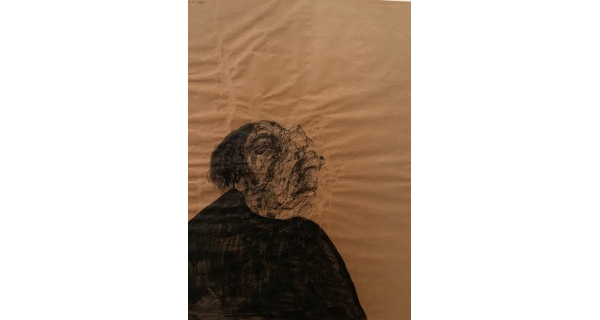
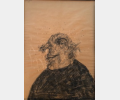
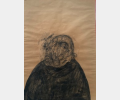
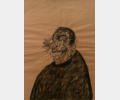
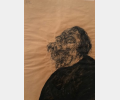
The creatures of Sabhan Adam grind their teeth, neck and heart. Their nerves were sawn from them. Irredeemable, they are, because they emerge from the opaque holes of culture. Torn off from nothingness, they will make fun of the beautiful until the end of time, the blinded marks from deep mental state, secret and denied, are born. Signs of humanity are born from an immense mass of a stained black abyss, and these signs have great difficulty to exist, themselves damaging existence. They dilate and are diluted, do not complain, and that gives vital outgrowths, gimicks of beings with terrifying and relentless presence. Metamorphic demonstrations of a cruel and grinding otherness. Fascinating proximity of the horror, in visual range, and of its infinite calmness.

The inside of the body is black. The eye is black. And even the horizon… Outside the black, Narcisse does not have any more to see, Adam has twisted his skin, and smashed all the mirrors. One sees nothing any more but our brothers hidden in the beyond. Obscure sarcastic and hard creatures, on edge. They seem to be born out of a female monster’s massive cocoon, giving birth on the side of life; when animality, freed at last, fertalizes humanity, and they ruin the bases of our conventions, and violently ransacks our appearances.

Sabhan Adam gets quickly and forcibly to the point, from the dark caves of original chaos, before the feeble lights of the day manufacture too fast a badly made human, polite, organized, and too well ordered. Adam does not cease to create disorder where it is necessary, which is everywhere there is pretence. Its mediums are hard like the desert wind. Its rare colors speak the naked language of the earth. Its drawing is like a brutal shiver, a instinctive, convulsive, and labyrinthian journey.


He is absolutely alone, however creates faces which look with obstinacy the strange faces of the spectator. If his art is poignant and fascinating, if it seizes us by the throat, if it is unaware of the weakness and tiredness of the day, it is that Adam, without peace nor end, is born from the night.


Untitled

Sans titre

Sans titre

Sans titre

Sans titre

Sans titre

Sans titre

Sans titre

Sans titre
1 - 2
 

Home / Exhibition(s) / News / Artists / Gallery / Press / Contact

Sitemap - legal

Powered by Novatix